Data / Forecasting, simulation & decisions
Predictive analytics
What happens if you make the next move?
Cashflow forecasting, AI prediction models and business simulations for hiring, marketing spend and growth decisions.
See what’s included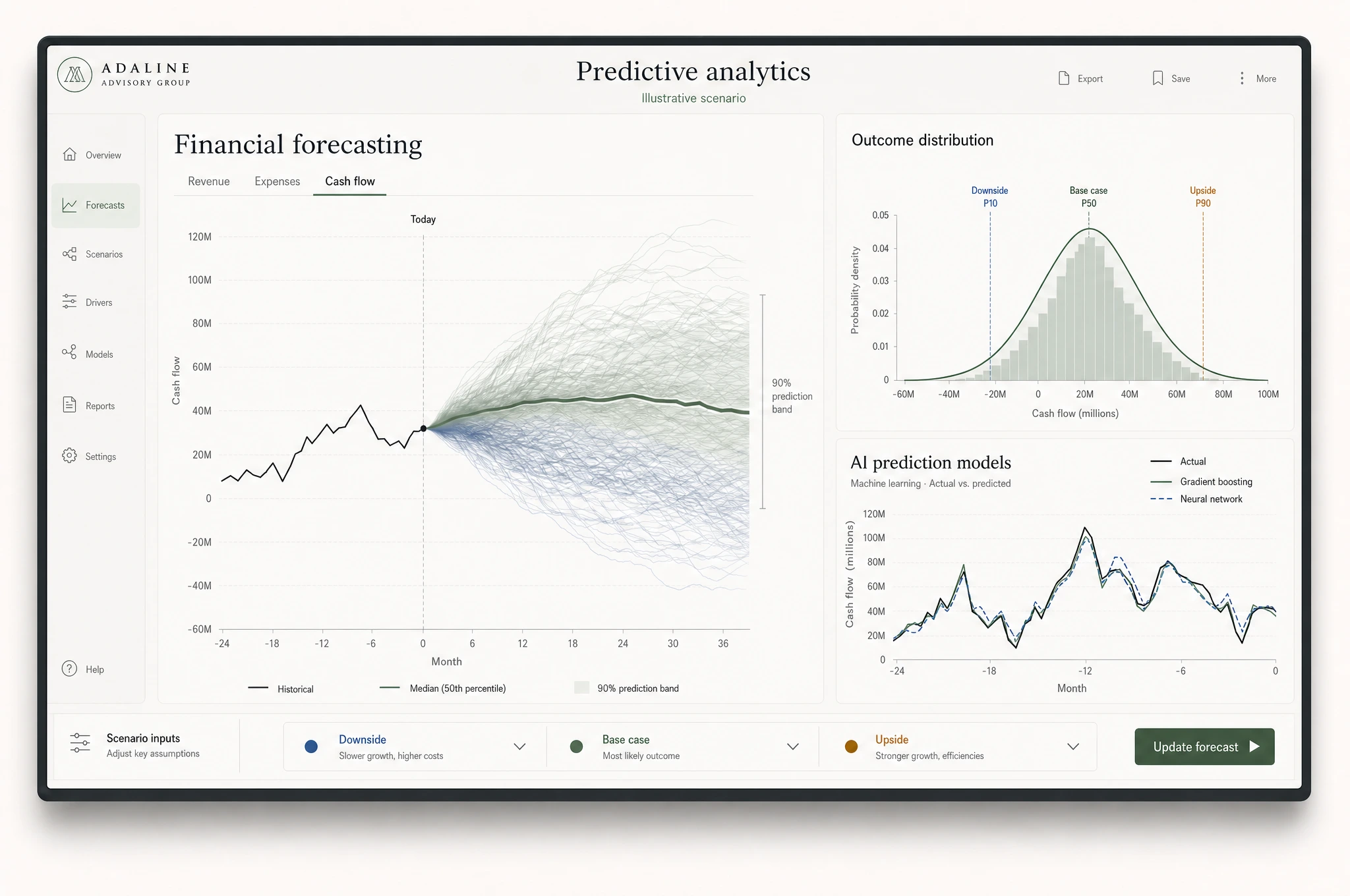

Make the next decision with a clearer view.
Understand how hiring, spending or payment delays could affect your cash. Compare options before you commit.
- Cashflow and financial forecasting
- Hiring and marketing-spend simulations
- A clear view of assumptions
Models built around the decision.
We choose the method to fit the question, data and time horizon. Your model should explain what changes the outcome and where uncertainty remains.
Cashflow and financial forecasting
Project cash inflows, payroll, operating costs and payment timing. Use statistical forecasts, machine learning and AI prediction models where they improve validation results, with a clear view of cash runway and funding needs.
Monte Carlo cashflow simulations
Simulate many combinations of uncertain sales, collections and costs. Estimate a range of cash balances and the probability of falling below an agreed cash threshold, based on the model’s assumptions.
Sensitivity and scenario analysis
Use sensitivity analysis to identify the assumptions that matter most. Use scenario analysis to compare coordinated changes such as slower sales, higher payroll and later customer payments.
Reverse stress testing
Start with an unacceptable outcome, such as running out of cash, and work backwards. Identify combinations of lost revenue, rising costs or collection delays that could cause it.
Markov models and customer lifetime value
Model transitions between customer states such as first purchase, repeat purchase and churn. Run customer lifetime value and marketing simulations to compare acquisition spend, retention efforts and long-term contribution.
Decision trees and system dynamics
Compare choices and uncertain branches with decision trees and expected value optimization. Use system dynamics to represent feedback and delays between hiring, capacity, sales, service quality and demand.
Bring us the “what if?”
These are examples of decisions we can model. The answers come from your data and agreed assumptions.
- What if we hire three more sales reps over the next two months?
- Compare hiring dates, ramp-up time, lead availability, conversion rates and payroll. Forecast the effect on revenue, cash runway and when the additional capacity could pay for itself.
- What if we double spending on marketing ads?
- Model acquisition cost, diminishing returns, conversion lag, customer lifetime value and delivery capacity. Compare expected contribution and cash requirements across spending levels.
- How much disruption can our cashflow absorb?
- Stress collection times, lost customers and supplier costs. Identify the combinations that breach your cash threshold and test which actions provide the most room to respond.
- Should we expand now, phase the investment or wait?
- Use decision trees to compare probability-weighted value and downside. Account for the cash needed at each stage and the information a smaller first step could reveal.
What you get.
- A forecast or simulation model with visible assumptions
- A dashboard comparing baseline, alternatives and outcome ranges
- A record of validation, key drivers and model limitations
- A decision brief covering expected value, downside and cash requirements
- A process to update the model with actual results

See more than one possible future.
A single forecast can hide the risk. We model a range of outcomes and show which conditions would change the decision.
- Scenario and sensitivity analysis
- Cashflow stress tests
- Models refreshed with actual results
Compare your planning tools.
A single forecast gives one number and false certainty. Compare it with a model that shows the range of outcomes and the assumptions that could change the decision.
| Compare the features | Static spreadsheetOne manually maintained plan | Adaline predictive analyticsModels for your decisions | Past-performance reportWhat has already happened |
|---|---|---|---|
| Cashflow forecast | Included: One manual version | Included: Built for your decisions | Not included: Only looks backward |
| Compare scenarios side by side | Partly, with extra effort: Copies of copies | Included: Side by side, in one model | Not included: Not possible |
| Show a range of outcomes | Not included: One number, false certainty | Included: Best, likely and worst case | Not included: History only |
| Make key assumptions visible | Partly, with extra effort: Hidden inside formulas | Included: Clearly surfaced | Partly, with extra effort: Past drivers only |
| Simulate hiring or ad spend | Partly, with extra effort: Fragile custom formulas | Included: Test it before you commit | Not included: Not possible |
| Stress-test cash requirements | Not included: Rarely done until it’s urgent | Included: See when cash could run tight | Not included: Not possible |
| Check against actual results | Partly, with extra effort: If someone remembers | Included: Compared each cycle | Included: Historical reporting |
| Refresh with new data | Partly, with extra effort: Manual re-entry | Included: Agreed update process | Partly, with extra effort: Depends on reporting setup |
Capabilities are configured to your package. Integrations, usage limits, support and any ongoing costs are agreed before work begins. Forecasts depend on data and assumptions; they do not guarantee future outcomes.
How we get started
Define the decision, data and success criteria
Validate a baseline and simulate the alternatives
Compare tradeoffs and refresh with actual results
A package built around your business.
Speak with a team member for pricing. We’ll help you choose the right scope and level of support. Your quote sets out the work, integrations, timeline and any ongoing costs before you commit.